Keynote Speakers
Keynote: Archana Venkataraman
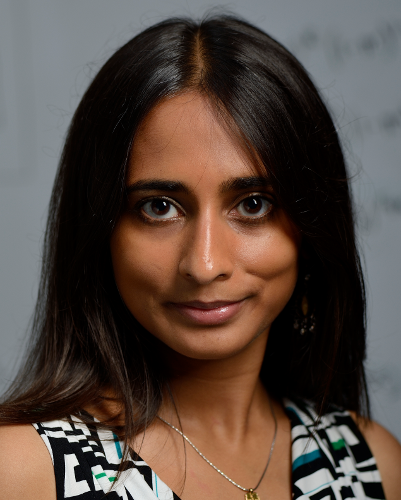 Archana Venkataraman is an Associate Professor of Electrical and Computer Engineering at Boston University. From 2016-2022, she was an Assistant Professor at Johns Hopkins University. Dr. Venkataraman directs the Neural Systems Analysis Laboratory and is affiliated with the Department of Biostatistics, the Department of Biomedical Engineering, the Center for Brain Recovery, and the Rafik B. Hariri Institute for Computing at Boston University. Dr. Venkataraman’s research lies at the intersection of biomedical imaging, artificial intelligence, and clinical neuroscience. Her work has yielded novel insights into debilitating neurological disorders, such as autism, schizophrenia, and epilepsy, with the long-term goal of improving patient care. Dr. Venkataraman completed her B.S., M.Eng. and Ph.D. in Electrical Engineering at MIT in 2006, 2007 and 2012, respectively. She is a recipient of the MIT Provost Presidential Fellowship, the Siebel Scholarship, the National Defense Science and Engineering Graduate Fellowship, the NIH Advanced Multimodal Neuroimaging Training Grant, numerous best paper awards, and the National Science Foundation CAREER award. Dr. Venkataraman was also named by MIT Technology Review as one of 35 Innovators Under 35 in 2019.
Talk title: Lightweight and Interpretable AI as a New Window into Brain Dysfunction
Deep learning has disrupted nearly every major field of study from computer vision to genomics. The unparalleled success of these models has, in many cases, been fueled by an explosion of data. Millions of labeled images, thousands of annotated ICU admissions, and hundreds of hours of transcribed speech are common standards for AI models. Clinical neuroscience is a notable holdout to this trend. It is a field of unavoidably small datasets, massive patient variability, and complex (largely unknown) phenomena. My lab tackles these challenges across a spectrum of projects, from answering foundational neuroscientific questions to translational applications of neuroimaging data to exploratory directions for probing neural circuitry. One of our key strategies is to develop both lightweight and interpretable models using domain knowledge.
This talk will highlight two ongoing lines of work that epitomize this strategy in the context of epilepsy. First, I will snapshot our work on seizure detection from scalp EEG. We use a simple transformer architecture to combine spatial and temporal information in the continuous EEG recordings. Our model accurately pinpoints, not only the time of seizure onset, but the involved areas of the scalp across a large clinical dataset. Second and as a follow-up, we ask the question: what specific attributes of the EEG signal lead the model to a seizure prediction? To answer this question, we use a contrastive training mechanism to align the EEG encodings from the model with textual concept embeddings derived from clinical notes. Using an attention-weighted pooling mechanism, we then detect patient-specific seizure and baseline etiologies.
Keynote: Jean Feydy
 Jean Feydy is a tenured research scientist at Inria Paris. Following a PhD on the mathematical foundations of shape registration and a postdoc focused on geometric deep learning for structural biology, he joined the HeKA team, a translational research unit dedicated to public health and computational anatomy. His research focuses on bridging the gap between domain-specific modelling constraints and fast GPU implementations. Jean maintains the PyKeOps and GeomLoss libraries: two PyTorch extensions for geometric machine learning and optimal transport that have been downloaded over a million times each. Currently, he is bringing scalable survival and shape analysis to clinical research through the survivalGPU and scikit-shapes projects.
Talk title: Geometric Insights on Matching Problems
Image registration, generative modelling and cohort balancing are all matching problems: they seek an assignment that best aligns two distributions of samples under a suitable, domain-specific regularization prior. In this talk, I will summarize insights from the past decade of theoretical research in the field. In particular, I will show how objectives penalizing distortions (leading to the “Gromov-Wasserstein” or “Quadratic” Assignment Problem) can always be understood as affine registration methods in a suitable feature space. This perspective unifies several lines of work and paves the way for robust optimization algorithms that can be used either as standalone tools or as flexible layers in machine learning pipelines.
Previous Keynote Speakers
2024 - Udunna Anazodo || Ehsan Adeli
2023 - Neda Jahanshad || Catie Chang
2022 - Marius de Groot || Thomas Yeo
2021 - Adrian Dalca || Paul Thompson
2020 - Duygu Tosun-Turgut || Jorge Cardoso
2019 - Yong Fan || Pamela Douglas
2018 - Christos Davatzikos || Gael Varoquaux || George Langs